The Home Robotics Leasing Market

Where Automation Meets Accessibility

Byron Arnao · Principal Technologist, AWS · May 2026

Why This Matters Now

For the past year, I've been building OpenClaw—a framework for autonomous AI agents that can execute real-world tasks without constant human oversight. The promise: agents that don't just answer questions, but do things.

Now, that same autonomy is leaving the screen and entering our homes—not as software, but as physical robots you can lease for $499/month.
This is the moment when agent intelligence meets physical embodiment—and it's rewriting the economics of home automation.

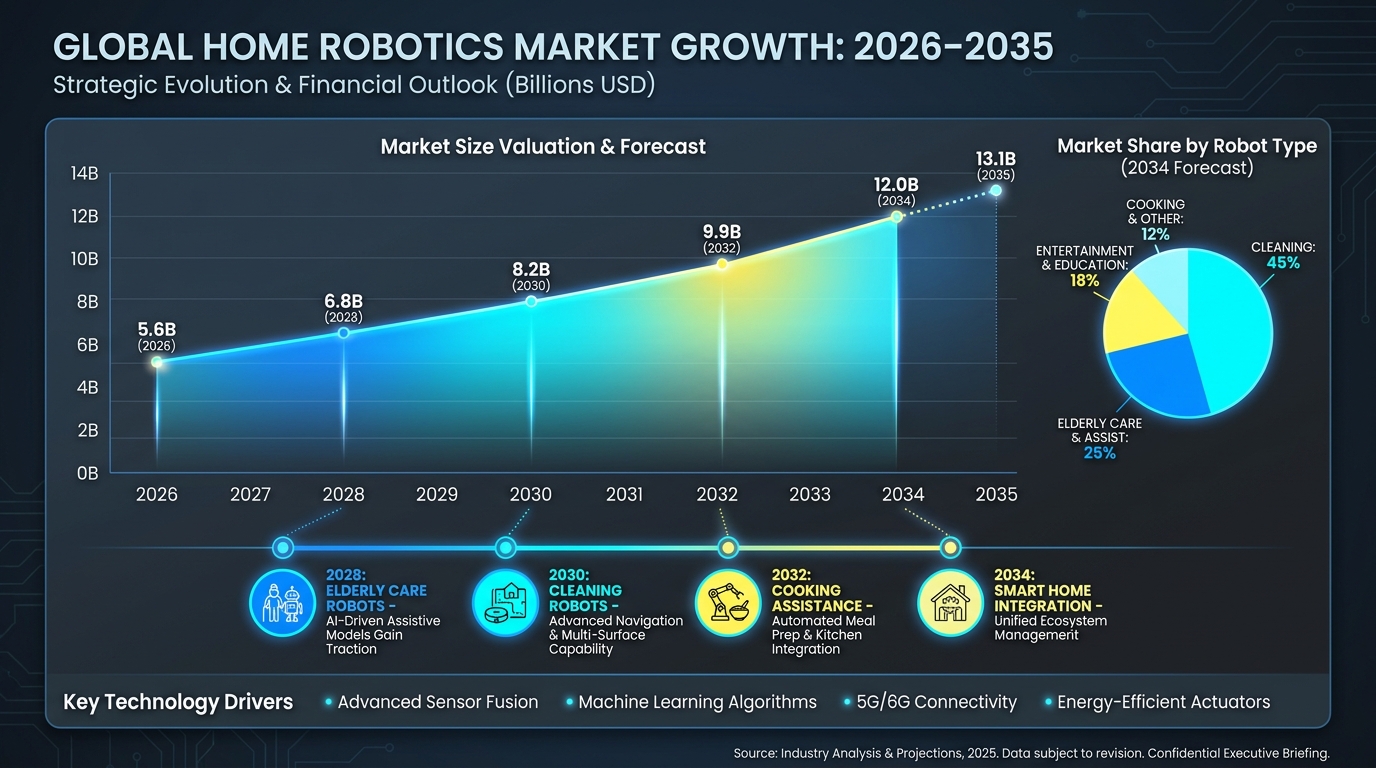
The Market in Numbers

Market Growth 2026-2035
  • Personal Domestic Service Robotics: $25.6B (2026) → $112B (2034)
  • RaaS (Robot-as-a-Service): 21.2% CAGR through 2035
  • Overall robotics market: 34% YoY growth in 2026 — fastest in a decade

Sources: GM Insights, Intel Market Research, Fortune Business Insights

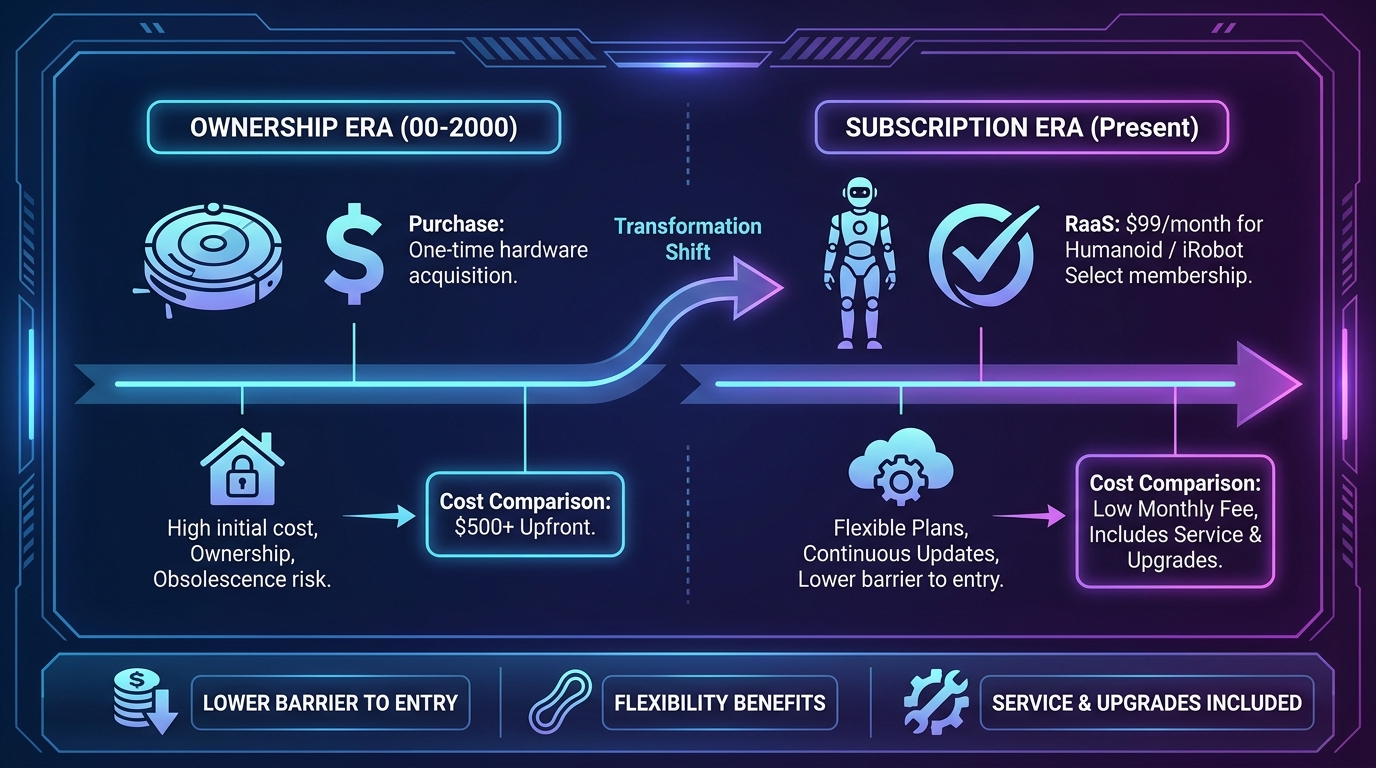
The Shift: Ownership → Subscription

Business Model Evolution
  • Old model: Buy a Roomba for $500-$2,000 upfront
  • New model: Lease a humanoid robot (1X NEO) for $499/month, hardware upgrades included
  • Why it works: Lower barrier to entry, continuous improvements, no obsolescence risk

iRobot Select (discontinued but pioneering), 1X Technologies NEO pre-orders

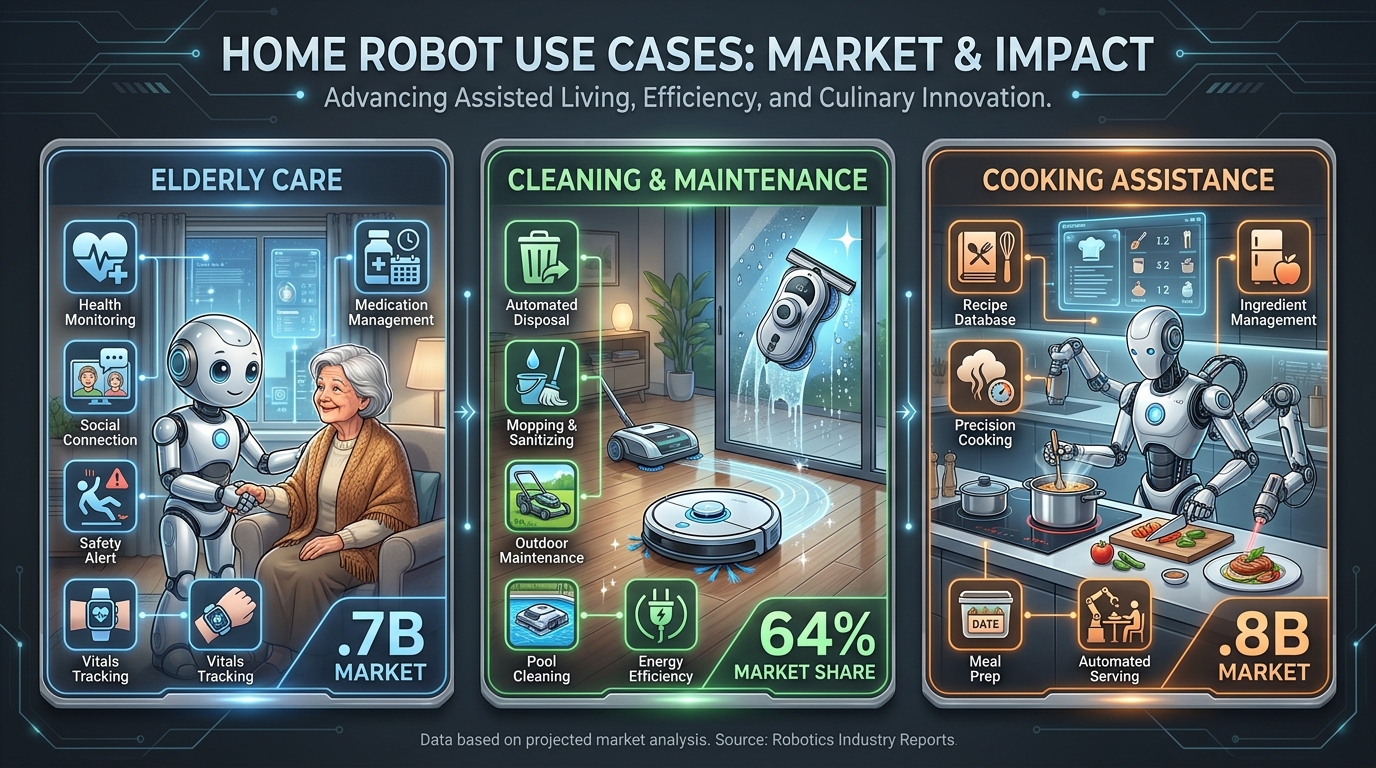
Three Major Use Cases Driving Adoption

Home Robot Use Cases

1. Elderly Care: The Biggest Opportunity

  • Market size: $3.7B (2026) → $6.12B (2034)
  • Capabilities:
    • Health monitoring (vitals, fall detection)
    • Medication reminders & dispensing
    • Companionship (Paro, ElliQ, Hyodol)
    • Mobility assistance & rehabilitation
  • Driver: Aging population + caregiver shortages

Persistence Market Research, IntelMarket Research

2. Cleaning & Maintenance: The Mature Segment

  • Market size: $16.9B (2026), 64.7% revenue share
  • Beyond vacuums: Window cleaning (Ecovacs Winbot), stair climbing (Roborock Saros Rover), shoe cleaning (Brolan ClearX)
  • CES 2026 trend: Humanoid robots folding laundry, loading dishwashers (LG CLOiD, SwitchBot Onero H1)
  • Why it dominates: Early commercialization, proven ROI, smart home integration

Mordor Intelligence, Coherent Market Insights

3. Cooking Assistance: The Emerging Frontier

  • Market size: $4.8B (2026) → $11.6B (2035), 12.9% CAGR
  • AI robo-chefs: Nosh, Wan AIChef Ultra, Suvie Kitchen Robot
  • Capabilities: Recipe generation from photos, precision cooking, automated meal prep
  • Barrier: High upfront cost — leasing models will accelerate adoption

Research and Markets, The Business Research Company

Key Players & Offerings (2026)

CompanyProductPrice Model
1X TechnologiesNEO (humanoid)$20K purchase OR $499/mo subscription
TeslaOptimus (humanoid)$20-30K (pilot stage)
Figure AIFigure 03 (humanoid)Sub-$20K target (TBD)
UnitreeG1 / R1 (humanoid)$16K / $4.9K + payment plans
iRobotRoomba (vacuum)SmartCare subscription (accessories)
EcovacsDEEBOT, WINBOTBNPL financing via Abunda

Insight: 12 commercial humanoid platforms now available for purchase or lease—transition from research to deployment

TheRobotReport, KeyiRobot, Abunda

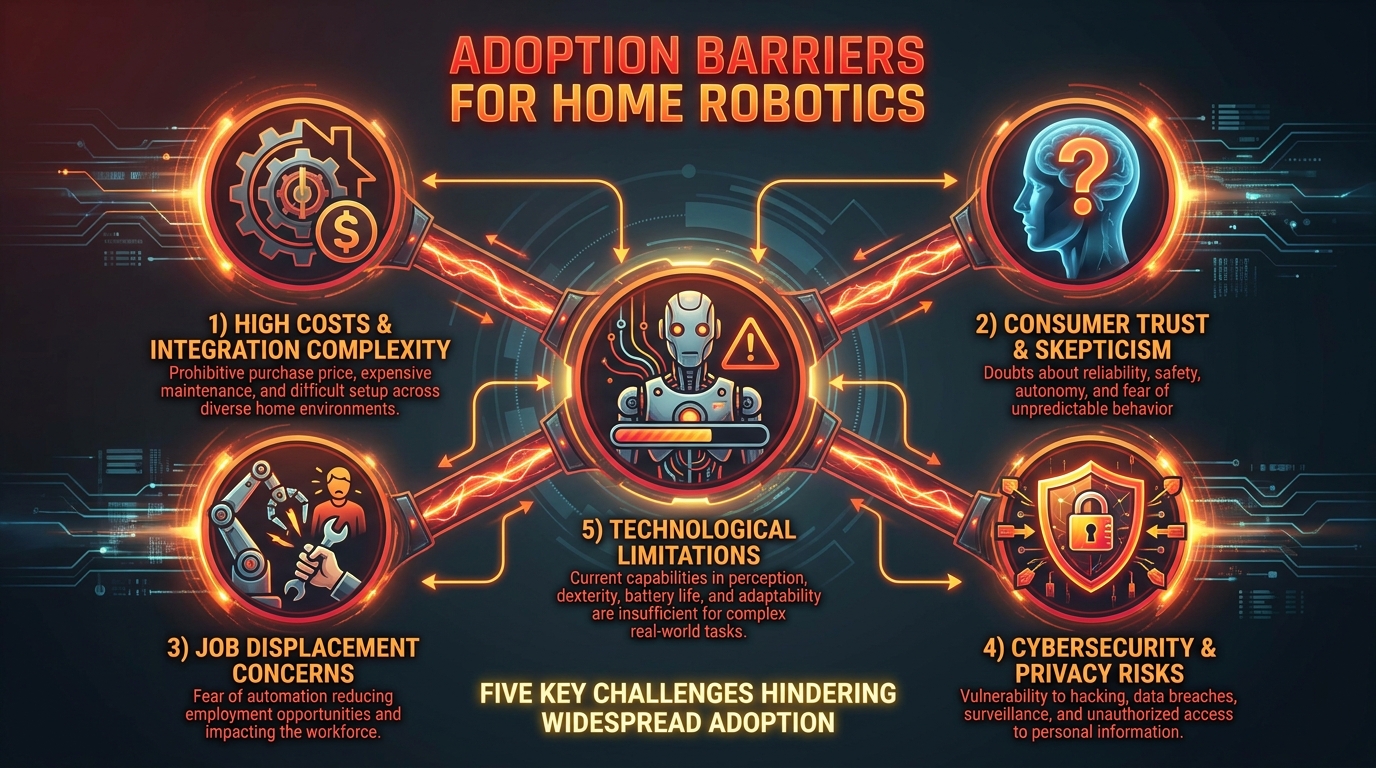
The Adoption Barriers

Adoption Challenges

Challenge 1: Consumer Trust

  • The problem: High skepticism toward AI-driven service robots
  • The "eeriness" factor: Over-humanization can backfire—consumers prefer robots that "feel" over robots that "think"
  • The "human premium": Counter-movement valuing human-made content & human customer service over AI
  • Mitigation: Human follow-up for complex tasks, transparency, consistent performance

Aalto University, Purdue University, UC Press Collabra

Challenge 2: High Costs & Integration

  • Initial deployment cost still substantial for SMBs despite subscription models
  • Integration with existing home systems requires technical expertise
  • Workforce training needed (especially for elderly care settings)
  • The RaaS promise: Lower barrier to entry, but not yet frictionless

Challenge 3: Cybersecurity & Privacy

  • Cloud-based RaaS → data privacy concerns
  • EU AI Act (2025-2026 phased rollout) → transparency obligations for high-risk AI
  • Connectivity dependence → single point of failure
  • Leadership lesson: Governance runtime is the moat, not the robot hardware

This mirrors the AWS Well-Architected principle: Security & governance are the product.

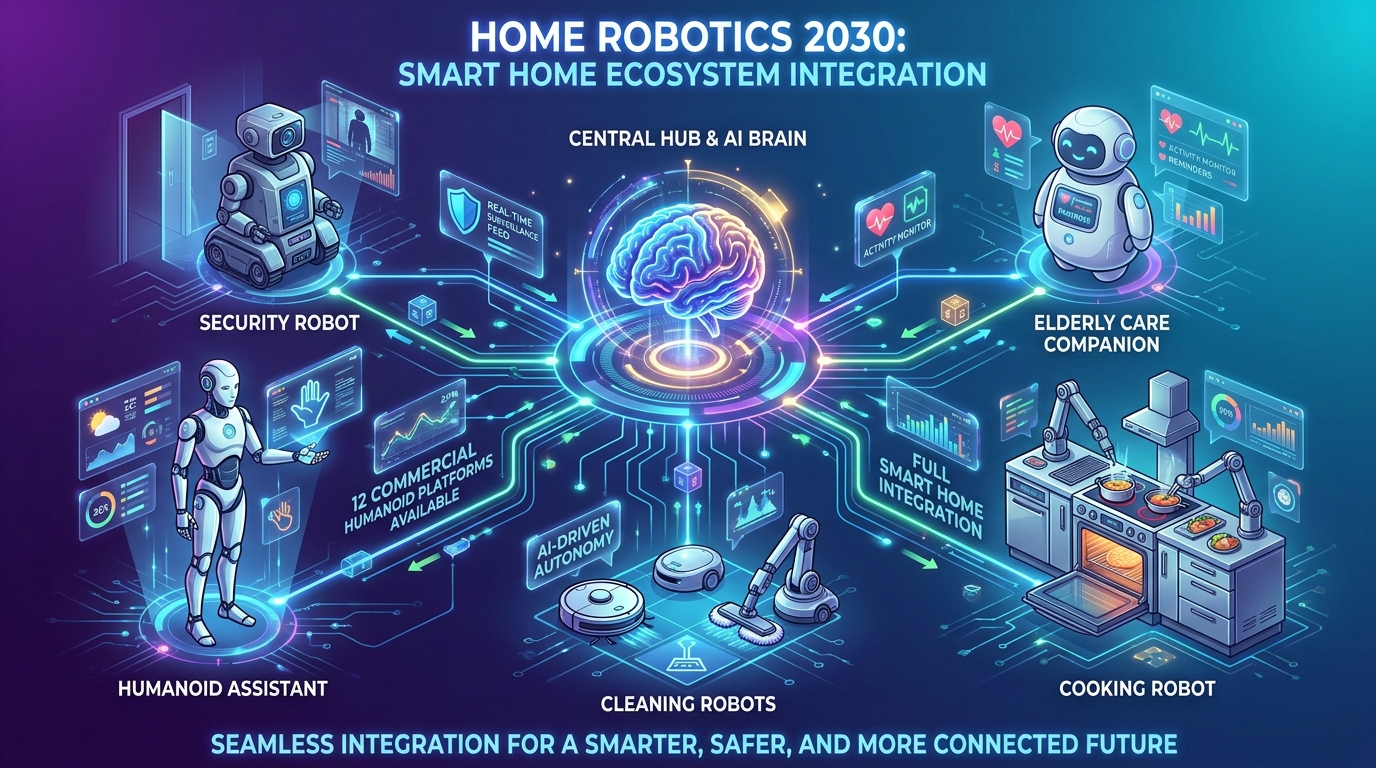
Where the Market Is Going (2026-2030)

Future Vision 2030

Prediction 1: Full Smart Home Integration

  • Robots won't be standalone devices—they'll be nodes in a smart home ecosystem
  • Central AI hub coordinating: cleaning, cooking, elderly care, security
  • Data sharing between robots → contextual awareness (e.g., cooking robot knows when cleaning robot finished kitchen)
  • The OpenClaw parallel: Multi-agent orchestration becomes the norm

Prediction 2: Humanoid Robots Become Mainstream

  • 2026: 12 commercial humanoid platforms available
  • 2030: Projected 50+ platforms, sub-$10K entry price
  • Key unlock: General-purpose form factor (hands, mobility) vs. task-specific robots
  • Use case expansion: Laundry, tidying, organizing, personalized assistance

Robotics Center AI State of Robotics 2026

Prediction 3: Subscription Becomes Dominant

  • Why: Hardware obsolescence is rapid—software updates + hardware swaps are the new value prop
  • Analogy: iPhone Upgrade Program → Robot Upgrade Program
  • Benefit: Continuous improvement without re-buying
  • Risk: Lock-in & vendor dependency—open standards will matter

Prediction 4: Asia-Pacific Leads Adoption

  • 2026: APAC = 29.9% global RaaS market share
  • Driver: Rising wages in China, government automation incentives, aging population in Japan/South Korea
  • North America: 34.3% share, mature innovation ecosystem
  • Europe: Fastest-growing region (regulatory clarity from AI Act)

GM Insights, Global Times

Prediction 5: Job Displacement → New Roles

  • Concern: Service industry displacement (retail, hospitality, home care)
  • Reality: New roles emerge—robot fleet operators, maintenance techs, AI trainers
  • Policy implication: Retraining programs critical for workforce transition
  • The human-machine collaboration thesis: Augmentation > replacement

Key Takeaways

  • $25.6B → $112B market by 2034—home robotics is no longer niche
  • RaaS subscription models unlock adoption by lowering upfront cost
  • Three use cases dominate: Elderly care (biggest growth), cleaning (mature), cooking (emerging)
  • Barriers are real: Consumer trust, integration complexity, cybersecurity
  • The future is integrated: Multi-robot ecosystems, humanoid generalists, subscription-first business models

What This Means for AI Builders

  • Agent autonomy is going physical—your software agents will need to coordinate with physical robots
  • Governance runtime is the moat—not the hardware, not the AI model. Identity, access control, observability.
  • Human-machine collaboration design matters more than pure automation—trust is the limiting factor
  • Subscription business models align incentives for continuous improvement—apply this thinking beyond robots

This is the decade when intelligent agents leave the cloud and enter our homes. Build accordingly.

References

  • GM Insights - Robotics as a Service Market (2026-2035)
  • Research and Markets - RaaS Market Report 2026
  • Intel Market Research - Personal Domestic Service Robotics Market
  • Mordor Intelligence - Domestic Service Robots Market
  • Fortune Business Insights - Household Robot Market
  • TheRobotReport - 1X Technologies NEO Pre-Order Launch
  • Persistence Market Research - Eldercare Assistive Robots Market
  • Aalto University - Consumer Perceptions of Service Robots
  • UC Press Collabra - Impact of Service Robot Communication Style
  • The Business Research Company - Cooking Robot Global Market Report
  • Robotics Center AI - State of Robotics 2026
  • Global Times - Robot Leasing Emerging Business in China
  • Future Market Insights - RaaS Market Trends & Opportunities
  • Coherent Market Insights - Residential Robotic Vacuum Cleaner Market
  • InsightAce Analytic - Eldercare-Assistive Robots Market

Let's Connect

Byron Arnao

LinkedIn: linkedin.com/in/sherpa
Email: byron.arnao@gmail.com
Projects: arnao.ai | agentsim.arnao.ai | moltbook.arnao.com
OpenClaw: Building the future of autonomous AI agents